Recently, I have started hearing the term SEL (social and emotional learning) more often in Taiwan’s education conversations. It shows up in teacher workshops and education news. The Ministry of Education has announced a five-year SEL plan, along with more training opportunities for teachers.
Why is everyone suddenly talking about SEL?
As an English subject teacher in an elementary school, I already dealt with students’ emotions in my classroom. I taught students who could have very intense emotional reactions, and conflicts between students came up.
If there was a teachable moment, I would talk about what happened and what they could do differently next time.
So when I started learning more about SEL, I had a simple question:
Haven’t teachers already been doing this?
What Is Different About SEL?
SEL is usually organized around five broad areas: self-awareness, self-management, social awareness, relationship skills, and responsible decision-making.
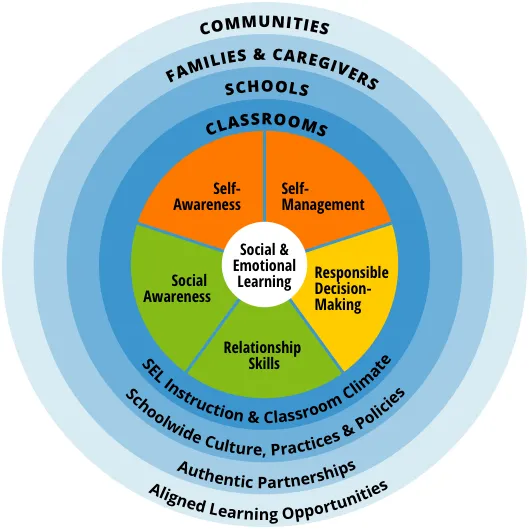
The CASEL framework places the five SEL competencies within classrooms, schools, families, and communities. Source: CASEL.
Teachers have always helped students manage frustration, resolve conflicts, work with other people, make choices, and understand how their behavior affects others. In Taiwan, ideas related to emotional education have existed in the curriculum long before SEL became such a visible term.
In 2025, Taiwan’s Ministry of Education announced the first phase of a five-year national SEL plan. The plan connects SEL with the existing curriculum, subject teaching, classroom management, teacher development, school culture, families, and communities. It also calls for developing approaches grounded in Taiwan’s own context.
Can Emotional Regulation Really Be Taught?
Imagine teaching a child what to do when they are angry. They can name their emotion. They can tell you that they should pause, calm down, or think before reacting.
In that moment, sitting calmly in a classroom, they know the answer.
But what happens the next time they are furious?
Knowing the answer when you are calm does not mean you can use it when you are angry.
That was one reason I was skeptical about the idea of “teaching” emotional regulation.
Research on school-based SEL made me reconsider that assumption. Studies have found positive effects on students’ social and emotional skills, behavior, relationships, emotional well-being, and academic outcomes.
I wanted to understand what “teaching” these skills meant.
It was more than explaining a strategy once. SEL can involve repeated practice, prepared teachers, classroom environments where students can use these skills, and support beyond a single lesson.
A lesson might give students language and strategies. The harder part comes when they are frustrated, angry, embarrassed, or in conflict with someone else.
I never thought of the small conversations I had with students during English class as SEL. They were just things that came up because I was teaching children.
What Happens When an Educational Idea Travels?
SEL did not originate in Taiwan. The framework most often associated with it was developed in the United States, particularly through the work of CASEL.
Taiwan has its own curriculum, school culture, expectations of teachers, relationships between families and schools, and pressures around academic achievement. Teachers have limited time and different levels of training and support.
This made me think about what happens when we bring an educational idea from one country into another. If research shows that an approach works, how much does its success depend on the conditions around it? Teacher preparation, school support, time, and family involvement may all shape what the same idea looks like in practice.
Taiwan’s national plan specifically mentions developing SEL approaches grounded in local experience. Research raises similar questions about how SEL works across different cultural contexts.
Is SEL Worth the Attention?
Teachers have always dealt with emotions, relationships, conflict, frustration, and decision-making because these things come with teaching children.
What feels different to me now is the idea of teaching these skills more systematically.
Instead of waiting for a conflict or emotional reaction to happen and then talking to students about it, SEL gives teachers a framework and shared language to work with. Students can have more opportunities to learn, practice, and come back to these skills over time.
I am curious to see how this will work in Taiwanese classrooms and what teachers will do with it in practice.
Sources
- CASEL. CASEL's SEL Framework.
- Ministry of Education, Taiwan. Social and Emotional Learning Mid- and Long-Term Plan, Phase One Five-Year Plan (2025–2029).
- Cipriano, C., et al. The State of Evidence for Social and Emotional Learning: A Contemporary Meta-Analysis of Universal School-Based SEL Interventions. Child Development, 2023.
- Li, A., Miller, F. G., & Williams, S. C. Cultural Adaptations to Social-Emotional Learning Programs: A Systematic Review.